From Howell's Cross Roads to the 1876 charter and Georgia's first woman mayor: Duluth's history, the 1871 depot, the Calaboose and the Superb rail car.
Last checked Oct. 6, 2026. Facts on this page come from the City of Duluth’s Our History page, the Duluth Historical Society, the Southeastern Railway Museum and the National Park Service’s National Register of Historic Places data. Duluth Historical Society: 770-403-1795, info@duluthhistoricalsociety.org.
Duluth began as a crossroads on the edge of the Cherokee lands and grew into a railroad and cotton town. Its name, borrowed from a city in Minnesota, started as a joke in Congress. All dates below are as the city and the organizations named publish them.
Visit
- Duluth Historical Society, in the Duluth Train Depot: 3595 Buford Hwy.; 10 a.m. to 5 p.m. Thursday to Saturday, 1 to 5 p.m. Sunday; tours by appointment, 770-403-1795
- Southeastern Railway Museum: 3595 Buford Hwy.; 10 a.m. to 5 p.m. Thursday to Sunday
- The Calaboose: downtown near City Hall and the Duluth Church Cemetery; viewable through its window, open during the Duluth Fall Festival
From Howell’s Cross Roads to Duluth
According to the city’s history page, the area was part of Cherokee territory in the early 1800s. Gwinnett County was created by the General Assembly in 1818, opening the land to settlers. Evan Howell arrived from Cabarrus County, North Carolina, in 1821, settled near the Chattahoochee River and became the first successful farmer and merchant, running a plantation and a cotton gin. In February 1833 he won permission to build a road from the river across his land to Peachtree Road, and the junction became known as Howell’s Cross Roads, a name it kept for 40 years.
| Year | Event, as the city records it |
|---|---|
| 1821 | Evan Howell settles the area |
| 1871 | The railroad reaches Duluth; the Methodist church forms; the depot is built |
| 1873 | The town is renamed Duluth after the railroad is completed |
| 1876 | The Georgia General Assembly approves Duluth’s charter |
| 1880 | John Knox is elected the first mayor, serving until 1885 |
| 1886 | The Baptist church is organized |
| 1904 | The Bank of Duluth, the first bank, opens |
| 1906 | The town is incorporated as the City of Duluth |
| 1909 | The Calaboose, the town jail, is built |
| 1922 | Alice Harrell Strickland is elected Georgia’s first woman mayor |
| 1943 | Joan Glancy Hospital, Gwinnett’s first hospital, opens |
| 1982 | The former First Baptist Church building becomes City Hall |
The city calls Duluth the fourth-oldest chartered city in Gwinnett County, after Lawrenceville, Norcross and Buford.
Why “Duluth”?
The city’s account: Kentucky Congressman J. Proctor Knott gave a speech to the U.S. House, “The Glory of Duluth,” making fun of Duluth, Minnesota. When the line through Howell’s Cross Roads was finished in 1873, the town took the name Duluth. Proctor Square and Knott Street are named for the congressman, and the city counts Duluth, Minnesota, as a sister city.
Alice Harrell Strickland
Alice Harrell Strickland (1861-1947) was elected mayor in 1922, the first woman mayor in Georgia, according to the city’s history page; the city’s list of former mayors shows her in office in 1923. She promised to “clean up Duluth and rid it of demon rum,” opened her home for children’s tonsil operations before the town had a hospital, and donated an acre for a community forest. The city says her home has been designated a historic site by the Georgia Historical Society.
The depot, the Calaboose and downtown
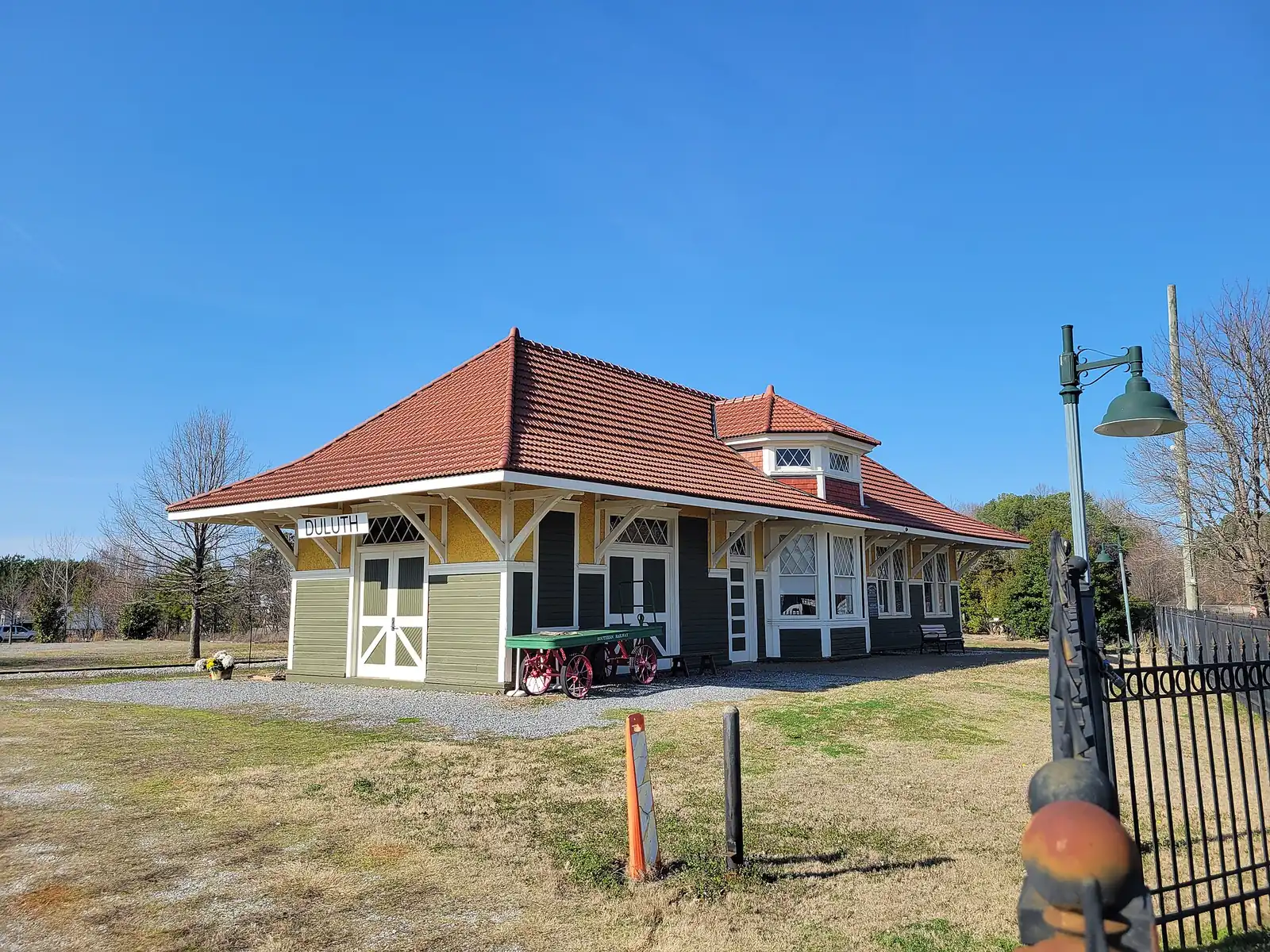
The Duluth Train Depot was built in 1871, according to the Duluth Historical Society. It closed by the early 1950s, was moved to Pleasant Hill Road in 1975 by developer Scott Hudgens, moved again to W.P. Jones Park in 1986, and arrived at the Southeastern Railway Museum in August 2008. The city still owns it. The historical society moved in at the end of 2014 and runs exhibits there.
The Calaboose, built in 1909 for $500 with 17-inch concrete walls, replaced the practice of locking people in railroad cars, according to the city’s Calaboose page. It stands downtown near City Hall and the Duluth Church Cemetery. The historical society opens it during the Duluth Fall Festival, held the last weekend of September; the rest of the year, visitors can look in through the barred window.
Downtown. The city approved a plan to restore downtown and preserve its older buildings in 1998 and began carrying it out in 2000. The bell cupola on the Festival Center was paid for mostly by the Fall Festival Committee. City Hall, at 3167 Main St., stands at the end of the Town Green.
On the National Register
The National Park Service’s National Register data (file dated May 22, 2026) lists one property in Duluth:
| Property | Address in the listing | Listed | Significance |
|---|---|---|---|
| The Superb | 3595 S. Old Peachtree Road | March 9, 1999 | National: transportation, engineering, politics and government |
The Superb is a Pullman private car built in March 1911, which the Southeastern Railway Museum calls the second-oldest steel private car in existence. President Warren G. Harding used it on his 1923 cross-country tour, and it carried his casket from San Francisco to Washington and on to Marion, Ohio. It was later renamed “Pope Pius XI” and “Los Angeles” and served as a railroad office car. It is on display at the museum.
Other Gwinnett County listings nearby include the Gwinnett County Courthouse in Lawrenceville (1980), the Norcross Historic District (1980) and the Suwanee Historic District (2013).
Museums to visit
- Southeastern Railway Museum, 3595 Buford Hwy.: 35 acres of historic rail and transportation equipment and train rides. Open 10 a.m. to 5 p.m. Thursday through Sunday; see the museum’s visitor page.
- Duluth Historical Society, in the depot at the same address: 10 a.m. to 5 p.m. Thursday to Saturday and 1 to 5 p.m. Sunday, as the society lists them. The city’s history page gives different seasonal days, so call 770-403-1795 before a special trip.
- McDaniel Farm Park, 3251 McDaniel Road: a Gwinnett County park restored as a 1930s farm, owned by the McDaniel family from 1859 to 1999; see our parks guide.
Frequently asked questions
When was Duluth, Georgia, founded? Evan Howell settled the area in 1821. The town took the name Duluth in 1873, and the Georgia General Assembly approved its charter in 1876.
Why is Duluth, Georgia, named after Duluth, Minnesota? The city says Kentucky Congressman J. Proctor Knott mocked Duluth, Minnesota, in a speech to the U.S. House, and the Georgia town took the name in 1873.
What is on the National Register of Historic Places in Duluth? One listing: The Superb, a 1911 Pullman private car used by President Warren G. Harding, listed March 9, 1999.
More: Duluth population and growth, things to do this month and Duluth, Gwinnett County and the neighbors.
Have your say